
PK-12
In-school and after school music programs taught by vetted Jammcard musicians. One contract, one invoice.
55+ schools and districts trust School Gig

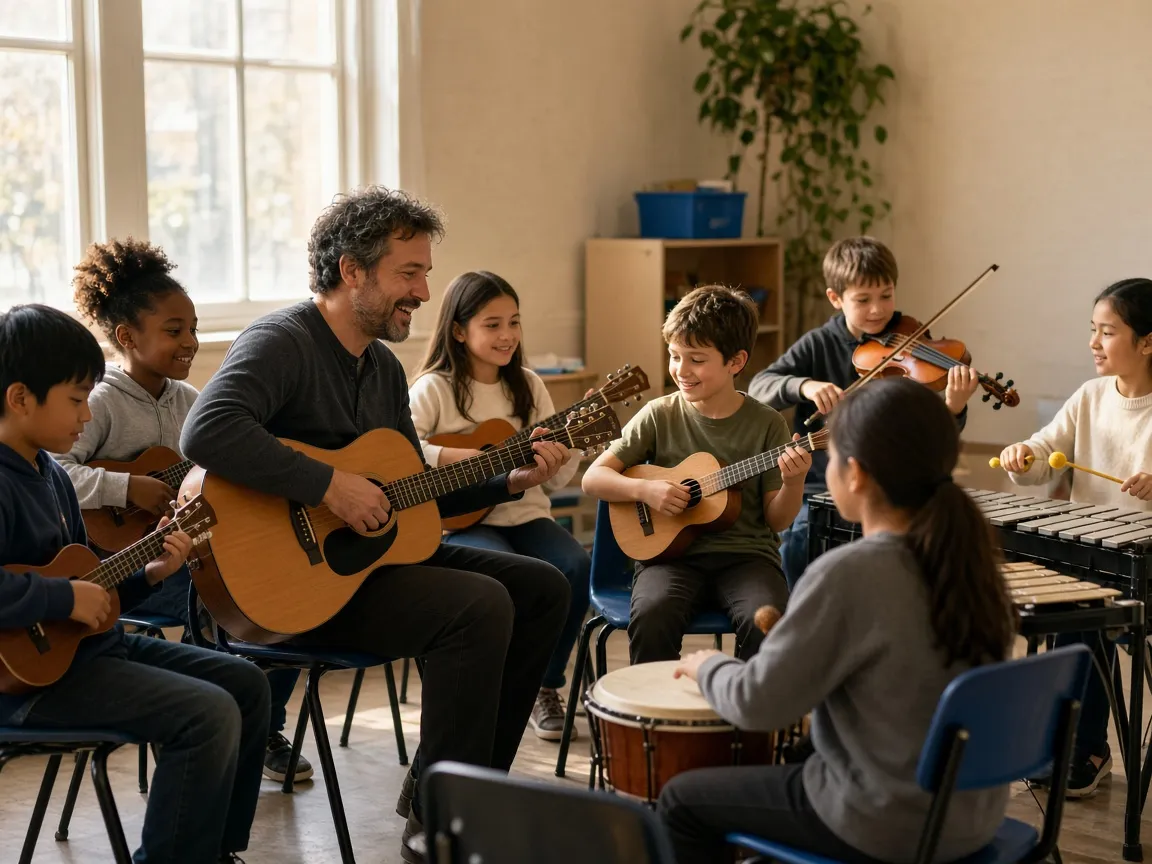
New to School Gig? We're the hiring platform PK-12 schools use to find arts educators. Now we bring music programs to your campus, too.
Music programs for schools bring professional musicians to campus to teach during the school day. After school music programs run once classes end, or in summer enrichment. With School Gig, you share your grades, schedule and goals. We match the musicians, and School Gig handles the contract, scheduling and billing, so you sign one agreement and get one invoice.
See School Gig in ActionPrograms
Programs for elementary, middle and high school, matched to your grades and goals.

Band & ensemble

Choir & general music

Strings

Piano & keyboard

Drums & percussion

Production & songwriting
How it works
From first call to first class, School Gig runs the process.
Step 1
Share your grades, schedule, budget and goals.
Step 2
We match you with the right musicians and send one simple proposal and contract.
Step 3
Musicians teach on your campus. School Gig handles billing and check-ins.
In-school · After school · Enrichment
✓ PK-12 principals and administrators
✓ District arts and enrichment coordinators
✓ Charter and private schools without a full-time music teacher
✓ After-school and expanded learning program leads
✓ Programs for elementary, middle and high school
✓ Vetted musicians from the Jammcard network
✓ One contract and one invoice from School Gig
✓ One point of contact, planning to wrap-up
✓ Fingerprint clearance per your district's requirements

The Jammcard network
Programs are taught by experienced, vetted musicians from the Jammcard network. School Gig is part of Jammcard, so you never manage multiple vendors: School Gig owns the relationship, the contract and the billing.
General music · Instruments · Songwriting · Production · Ensemble

One contract and one invoice, from first call to final concert.
Get a program idea for your school
Share your grades and schedule. We'll send next steps.
Funding
Your district decides how its funds are used. Here is a summary of CDE guidance; check each program's current guidelines.
• Districts with 500+ students spend at least 80% on certificated or classified staff. Up to 20% can go to training, supplies and arts educational partnership programs, which include outside contractors.
• Districts under 500 students are exempt from the 80% rule, and the CDE can grant a waiver for good cause.
• During the regular school day, students must be supervised by a certificated district employee.
Source: California Department of Education, Prop 28 FAQ #13–14
Grants
Funding sources schools often look at. Each funder sets its own rules. If you apply, we can share a quote and program description to include.
Federal
Districts receiving more than $30,000 in Title IV-A must spend part of it on well-rounded education, which can include music and arts programs, and can partner with nonprofits and community organizations.
Federal · After school
Federal funding for before-school, after-school, summer and break programs. Music and arts are named among the allowed enrichment activities.
State · California
Supports student attendance at performances and in-school assemblies by arts practitioners. Nonprofits, public agencies and tribal governments apply, working with school partners. Requests of up to $25,000.
Instruments
Donates student-model instruments, not cash, to public and charter schools with established in-school music programs where at least 65% of students are economically disadvantaged. Invitation only, after a pre-qualification form.
Recognition
Schools and districts can apply for BCME recognition. Winners serving under-resourced communities may receive a $5,000 award. NAMM's other grants go to 501(c)(3) nonprofits, not K–12 schools directly.
Local
Many county arts councils, district education foundations and PTAs fund school arts. Check with your county arts agency and local foundation for current cycles.
Grant details change; confirm eligibility and deadlines with each funder. School Gig doesn't apply for or guarantee funding.
Everything your business office asks for, from one partner.
📄 W-9 · 🛡️ Certificate of insurance (on request) · ✍️ One contract · 🧾 Itemized invoices · 📋 Program description for your plan
Looking at Prop 28, ELO-P or grant funds? Talk through your options with our team. Your district and each funder decide eligibility.
Talk Through Funding OptionsCredentials
Three common routes. Your district's credential office makes the final call.
Recommended · Fastest to start
A working musician from the Jammcard network leads the program while your in-house credentialed teacher stays in the room.
See details
• No new hire or credential search, so programs can start sooner.
• Prop 28: as an outside provider, this may fall within the up-to-20% arts educational partnership share. Your district decides.
• ELO-P: after-school staff need the district's instructional-aide minimums, not a teaching credential.
Single Subject Music (VAPA)
Teaches general-ed music on their own: band, choir, theory, appreciation.
See details
• Prop 28: can count toward the 80% staff share when the district employs them.
• School Gig: we can help you search for one. Expect a longer search.
CTE · Arts, Media & Entertainment
Teaches CTE-designated courses, such as Performing Arts or Production pathways, generally grades 7–12.
See details
• Requires 3 years of related industry work. It doesn't automatically cover general-ed or elementary music.
• Prop 28: can count toward the 80% when employed by the district.
• School Gig: we can search for CTE hires too. Expect a longer search.
Sources: CTC Prop 28 guidance (ctc.ca.gov/employers/assignment-resources/prop-28), CTC CL-888, CDE Prop 28 FAQ, CDE ELO-P FAQ.
Find the Right Fit for Your SchoolCalifornia law requires fingerprint-based DOJ/FBI background clearance for contractor staff who work with students, and many districts also require TB risk screening. We confirm your district's exact requirements (clearance, TB screening and insurance certificates) during scoping, before anyone works with students.
Meet the musicians
Jammcard is the music professionals network, and musicians join through a membership application. We match working musicians from the network to your grades, schedule and goals, and introduce them to you before the program starts.
Meet Musicians for Your SchoolTestimonials
Quotes from schools using School Gig to hire educators.
“SchoolGig made my job easier. Within days, they delivered qualified candidates that led to multiple offers.”
Patrick Sullivan
Director of HR, Compton Unified School District
“My job post sat unfilled for months. SchoolGig found qualified candidates that led to a hire within 8 weeks.”
Shane Schmeichel
Director of Special Programs, Coronado Unified
“This is so much easier to use than EDJOIN. It has more features and the pricing is more competitive.”
Nikki Manibhai
HR and Operations Director, P.S. Arts
“
School Gig has made my job easier. If you’re looking for arts educators, School Gig is a must try.
Patrick Sullivan
HR Director, Compton Unified
Schools we've worked with
Join over 55+ schools and districts that trust School Gig.
Compton Unified School District · Coronado Unified School District · P.S. ARTS · San José Unified School District · Inglewood Unified School District · Claremont Unified School District · Morongo Unified School District · Swing Education
Bring Music to Your SchoolFAQ
How do I start a music program at my school?
Tell us your grades, schedule, budget and goals. We match you with vetted musicians and send one proposal and contract. Then the program runs on your campus while we handle billing.
Do you offer after school music programs?
Yes. Programs can run during the school day, after school or as enrichment.
Who do we sign the contract with?
School Gig. You sign one agreement and get one invoice from us, even when Jammcard network musicians deliver the program.
How much does a school music program cost?
It depends on program length, group size and format. Pricing is scoped per school, so request a quote and we'll send one with a program description you can share.
Can Prop 28 or ELOP funds pay for a music program?
They may, within each program's rules. Under Prop 28, districts with 500+ students can use up to 20% of funds for arts educational partnership programs, which include outside contractors. ELO-P funds TK–6 after-school and summer enrichment and encourages community partners. Your district decides eligibility, so check each program's current guidelines. See funding details above.
What grants are available for music programs in schools?
Common sources include federal Title IV-A (well-rounded education) and 21st Century Community Learning Centers (after school), state arts council grants such as the California Arts Council's Arts Education Exposure, and Mr. Holland's Opus Foundation for instruments. Each funder sets its own eligibility. See grant sources above.
Can grants pay for after school music programs?
Some can. The federal 21st Century Community Learning Centers program funds after-school and summer programs and lists music and arts as allowed activities. In California, ELO-P also funds TK–6 after-school enrichment. Each funder sets its own eligibility. Note that Mr. Holland's Opus only supports schools with in-school music programs.
What paperwork do vendors need to work with a school district?
We provide a W-9, certificate of insurance, one contract and itemized invoices. Your district may require additional forms; we'll complete them during onboarding.
Are the musicians background-checked?
Yes. Anyone working with students completes the fingerprint-based DOJ/FBI clearance California requires, plus any TB screening or other checks your district asks for. See our safety standards above.
Can a teaching artist teach music without a credential?
Yes, with a credentialed teacher of record in the room. California's CTC says classified staff and volunteers can lead music enrichment if the credentialed teacher stays present. If students earn a grade or credit, or the class counts toward instructional minutes, the instructor needs a credential.
What is the difference between a CTE credential and a Single Subject Music credential?
A Single Subject Music credential authorizes general-education music classes. A Designated Subjects CTE credential in Arts, Media and Entertainment authorizes CTE-designated courses, such as performing arts or music production pathways, generally in grades 7–12. It requires three years of related industry experience.
What is the fastest way to start a music program at our school?
Pair a working musician from the Jammcard network with your in-house credentialed teacher of record, who stays in the room. There's no new hire or credential search. As an outside provider program, it may fall within Prop 28's up-to-20% partnership share; your district decides. School Gig can also search for credentialed music or CTE hires, which takes longer.
Does Prop 28 require credentialed music teachers?
For districts with 500+ students, at least 80% of Prop 28 funds must employ certificated or classified staff. Outside contractors fall in the up-to-20% partnership share. During the school day, students must be under the immediate supervision of a certificated employee to earn instructional time.
Do after-school (ELO-P) music instructors need a teaching credential?
No. CDE says ELO-P staff counted in the 1:20 ratio must meet the district's minimum qualifications for an instructional aide, not a teaching credential. Districts set those qualifications, and fingerprinting rules still apply.
How quickly can we start?
It depends on your schedule, program size and district onboarding (clearances and contracts). We'll give you a timeline on your planning call.
Host a working musician for a set stretch of time
Recurring music instruction aligned to your goals
Cover leaves, vacancies and concert seasons
One partner. One contract. Live music for your students.
Book a short call to plan your program.
Let's get in touch
Tell us a little about your school. We'll reply with a program idea and next steps.